The transition to renewable energy sources is driven not only by environmental imperatives but also by economic factors, as the declining costs of solar and wind technologies have made these options increasingly competitive. Despite their environmental and economic advantages, the intermittency and variability inherent to these sources represent significant challenges to grid stability and energy supply reliability. The intermittent nature of these sources requires effective storage solutions to ensure a continuous and reliable energy supply. Energy storage increases grid resilience, allows greater penetration of renewables, and gives consumers more control over their energy consumption.
Energy storage systems (ESS) have emerged as essential elements to overcome these obstacles, balancing supply and demand, stabilizing grids, and empowering consumers. The concept of storage has evolved from simple battery systems to complex multi-megawatt installations that integrate into power grids and local consumers. The strategic implementation of these systems influences not only the technical operation of energy systems but also economic models and public policies. Understanding the applications, technologies, and differences between various types of renewable energy storage systems is fundamental for stakeholders to optimize their investments and strategies.
This article addresses the main advantages of energy storage, analyzes the most advanced technologies, and compares the operational and economic characteristics of large-scale photovoltaic plants and decentralized self-consumption systems. It aims to provide a holistic understanding of the role of storage in accelerating the transition to a sustainable energy future.
ADVANTAGES OF RENEWABLE ENERGY STORAGE
Improvement of Grid Stability and Ancillary Services
One of the main functions of energy storage is to contribute to grid stability by providing ancillary services such as frequency regulation, voltage support, and spinning reserves. As renewable penetration increases, the grid faces fluctuations that may compromise system reliability. ESS can absorb excess generation during periods of high renewable production and release energy during deficits, smoothing fluctuations and maintaining grid frequency within acceptable limits.
Management of Variability and Reduction of Surpluses
Renewable sources such as solar and wind are inherently variable, often producing energy surpluses during certain periods (e.g., sunny days or windy nights). Energy storage allows grid operators and producers to limit excess production by efficiently storing it and releasing it when needed, reducing waste and increasing the overall system efficiency. This solution is especially valuable in regions with high renewable capacity, where congestion or overgeneration problems are common.
Reduction of Demand Peaks and Load Leveling
Demand peak management consists of storing energy during low demand periods and releasing it during high consumption periods. This reduces operational costs and relieves pressure on grid infrastructure. For consumers, especially industrial and commercial companies, this translates into lower electricity bills and greater energy autonomy.
Facilitation of Renewable Integration and Market Flexibility
Storage systems act as a buffer allowing greater integration of renewable sources, ensuring reliable grid operation despite the unpredictability inherent to intermittent sources. They thus favor market mechanisms such as time-of-use tariffs, demand response, and capacity markets.
Promotion of Decentralized Energy and Microgrids
In remote or off-grid locations, the combination of storage with local renewable generation creates microgrids capable of operating autonomously, increasing energy access, strengthening resilience, and reducing dependence on imported fuels.
Support for Electric Vehicle (EV) Charging Infrastructure
The growth of EVs offers new integration opportunities for the grid. Storage systems can help manage increased load, enable vehicle-to-grid (V2G) services, and optimize charging schedules to coincide with periods of high renewable production.
RENEWABLE ENERGY STORAGE TECHNOLOGIES
Despite their environmental and economic advantages, the intermittency and variability inherent to these sources pose significant challenges to grid stability and energy supply reliability. The intermittent nature of these sources demands effective storage solutions to ensure continuous and reliable energy supply.
Battery Energy Storage Systems (BESS)
Lithium-Ion Batteries: Currently the most widely used due to their high energy density, efficiency above 90%, long lifespan (up to 10,000 cycles), and continuously decreasing costs. Suitable for a wide range of applications, from residential storage to large-scale, particularly effective for short- to medium-term storage needs.
Flow Batteries: Use liquid electrolytes stored in external tanks, allowing greater scalability and prolonged life cycles (up to 20,000 cycles). Indicated for large-scale applications requiring long discharge periods. They enhance grid stability.
New Chemistries: Emerging technologies such as sodium-sulfur or zinc-air batteries offer potential for specific applications where cost and sustainability are critical factors.
Pumped Hydro Storage (PHS)
A well-established technology involving two reservoirs at different elevations. During periods of excess renewable generation, water is pumped to the upper reservoir; during high demand, it is released through turbines to generate electricity. Accounts for more than 95% of the world’s energy storage capacity and offers high efficiency, about 70 to 80%, and large capacities.
Compressed Air Energy Storage (CAES)
A system where air is compressed in underground cavities or reservoirs. When needed, compressed air is expanded through turbines to generate power. Suitable for long-duration, large-scale storage, especially in regions with favorable geological formations.
Thermal Storage
Energy stored in the form of heat or cold, which can be used directly for heating, cooling, or converted back into electricity. Molten salts are widely used in Concentrated Solar Power (CSP) plants, enabling electricity generation even after sunset.
Supercapacitors and Superconducting Magnetic Energy Storage (SMES)
Supercapacitors and SMES offer rapid response, ideal for grid stabilization, frequency regulation, and power quality management. Although not suited for long-duration storage, they stand out in high-power applications.
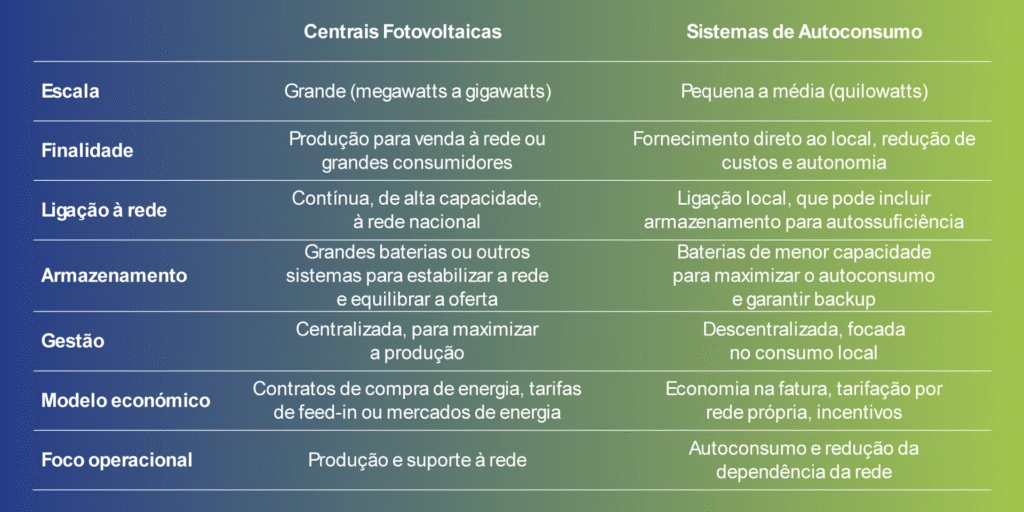
COMPARISON BETWEEN PHOTOVOLTAIC PLANTS AND SELF-CONSUMPTION SYSTEMS
CHALLENGES AND FUTURE PERSPECTIVES
Despite a promising outlook, several obstacles hinder widespread implementation:
High Costs: Although decreasing, battery costs remain substantial, especially for large-scale applications.
Environmental Concerns: The production and disposal of batteries raise environmental and ethical issues.
Technical Limitations: Durability, degradation, and safety of storage technologies require continuous improvements.
Large-Scale Integration: The rapid growth of large-scale renewable energy projects without a corresponding upgrade in storage capacity limits system reliability.
Emerging Technologies: Investments in solid-state batteries, thermal storage, and hybrid systems promise to increase storage capacity, improve efficiency, and reduce costs.
Fast and Flexible Response: Storage systems must evolve to provide faster responses, essential for frequency control and system stability.
Regulatory Barriers: Market structures and policies need to be adapted to encourage storage system deployment.
Looking ahead, innovations such as solid-state batteries, second-life electric vehicle batteries, hybrid storage systems combining different technologies, and advanced control algorithms are expected to improve performance and reduce costs. Additionally, integrating artificial intelligence and machine learning will optimize storage management, forecasting, and system operation.
The rapid growth of renewables, without a corresponding update in infrastructure and storage, could lead to uncontrolled blackouts, as happened on April 28, 2025, in Portugal and Spain. To mitigate these risks, investments are needed in grid modernization, storage systems, better operational coordination, and policies for managing energy production peaks.
CONCLUSION
Energy storage is a cornerstone for the sustainable integration of renewable energy sources. An example is the recent public tender in Portugal, worth 100 million euros, under the Recovery and Resilience Plan (PRR), aimed at funding energy storage projects that will allow the installation of 500 megawatts by 2026.
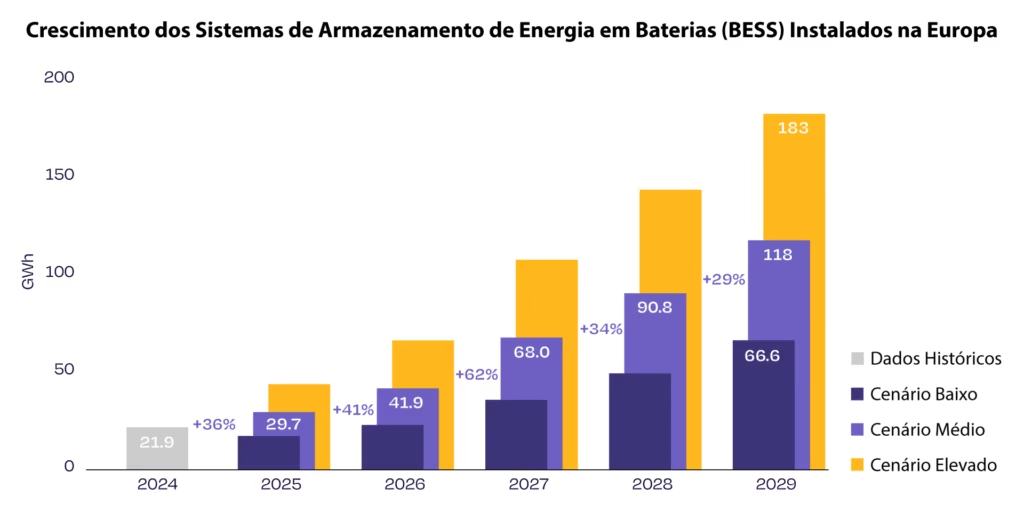
The battery energy storage system (BESS) market in Europe is expected to grow rapidly in the coming years, although still below necessary levels. The most likely scenario for 2025 forecasts the installation of 29.7 GWh of battery storage in Europe, representing an annual growth of 36% compared to 2024. By 2029, projections indicate an increase of about sixfold, reaching around 120 GWh.
Looking to the future, innovations such as solid-state batteries, second-life electric vehicle batteries, hybrid storage systems combining different technologies, and advanced control algorithms are expected to improve performance and reduce costs.
The applications of energy storage range from grid capacity stabilization and management to empowering consumers through self-consumption solutions. The diversity of storage technologies offers flexibility tailored to projects with different sizes and operational requirements.
Understanding the differences between large-scale photovoltaic plants and decentralized self-consumption systems is fundamental for designing efficient energy strategies. Both approaches, supported by technological advances in storage, will be essential to achieve a resilient and low-carbon energy future.
The continuous evolution of storage technologies, combined with supportive policies and market mechanisms, will accelerate the transition to cleaner and more sustainable energy systems worldwide.